Digital Banking
Core modernisation, digital channels, M&A integration and the operating models that let banks change products in weeks, not quarters.
Core banking modernisation
Six parts on replacing a bank's core without betting the bank: from why cores age badly to switching the old one off.
View the series →- 01Why cores age badly
- 02The business case
- 03Core banking modernisation without the big bang
- 04Running two cores on purpose
- 05The vendor selection scorecard
- 06Switching off the old core
All on Digital Banking
Wells Fargo takes tokenised deposits to corporate clients
A launch starting with dollar-to-sterling payments this autumn moves tokenised bank money from industry initiative to client product.
Klarna applies for a US bank charter through the ILC route
Buy now, pay later's largest player wants to bring its US banking in-house, joining PayPal and Affirm in the queue for industrial loan company charters.
Seventeen US banks back a shared network for tokenised deposits
The Clearing House's initiative puts on-chain settlement of bank money inside the existing banking system, connected to RTP and CHIPS.
Fiserv's agentOS turns the core provider into an agent platform
The largest US core provider now wants to run banks' AI agents as well as their accounts. That changes the build-or-buy question for every community bank.

Santander's Webster deal is a bet on deposits, not branches
A $12.2bn purchase aimed at fixing a funding gap shows what a US deposit franchise is worth, and why mid-sized banks with sticky commercial deposits are in play.

A 10% card rate cap would reprice risk, not remove it
The proposed cap on credit card interest is unlikely to become binding soon. Card issuers should still use it to stress-test who they lend to and why.

Seven shifts bank leaders should plan for in 2026
What the last quarter of 2025 tells boards and executive teams to put in next year's plan, and how strong the evidence is for each.
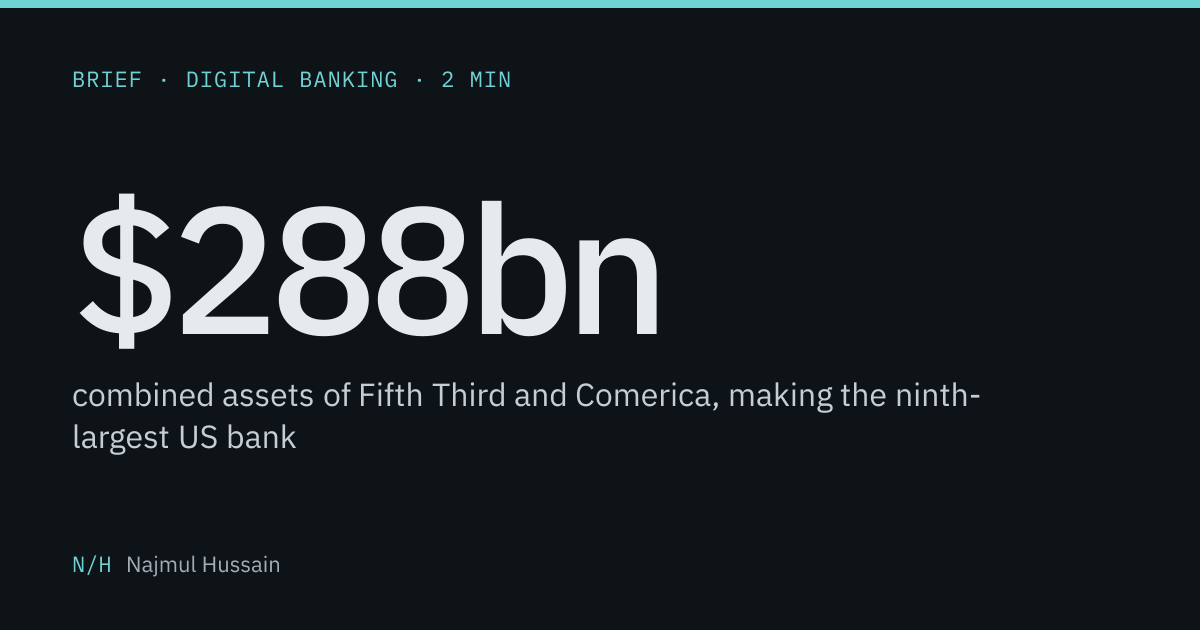
Fifth Third–Comerica: the $10.9bn case for regional scale
An all-stock deal creates the ninth-largest US bank and tests whether middle-market strength travels better inside a bigger balance sheet.

ANZ's 3,500-Job Cut: A Catalyst for Banking's Tech Transformation
ANZ's late-September 2025 announcement of roughly 3,500 job cuts (plus 1,000 contractors) — incurring a A$560m charge — has sent shockwaves through Australia's banking sector. Framed as a bid for efficiency, the move immediately provoked union disputes and prompted rival banks to seek their own cuts. For CIOs and digital leaders, this is a clear signal: legacy systems, outsourcing arrangements and tech budgets will all be scrutinized. Our analysis explains why this is more than just cost-cutting, and how it will reshape IT strategy and talent in banking.

Banks in the Fast Lane: Tech and Strategy Lessons from PNC’s $4.1B FirstBank Acquisition
PNC’s $4.1B FirstBank acquisition is big news—but it’s an even bigger test for banking CIOs. Beyond adding branches, it underscores how scale must be met with seamless tech integration and data-driven strategy. This deal’s lessons on deposit concentration, branch strategy and pricing power lay out the playbook for winning the next wave of consolidation.

Global Banking Rewritten: SMBC’s $1.6B Yes Bank Stake and the New Tech Playbook
Japan’s SMBC investing $1.6B in Yes Bank is more than a capital infusion – it’s a seismic shift. This deal signals a new era of cross-border fintech partnerships and competitive dynamics. Leading CIOs and tech leaders must take note: a new digital banking landscape is emerging.